Rattlesnake Lake and Rattlesnake Ledge near North Bend combine two of my favorite things about exploring Washington: a beautiful mountain lake and a forest hike with an incredible view waiting at the top.
But for me, Rattlesnake Lake is much more than a trailhead.
I’ve been coming here for years.
I brought my kids here when they were younger.
I’ve brought my nieces and nephews, and later… my grandkids.
We’ve packed countless picnics, enjoyed lazy afternoons along the shoreline, gone swimming, and simply enjoyed being outside together.
You could just come here for the hike up Rattlesnake Ledge, but honestly, you’d be missing out on half the fun.
Pack a picnic, give yourself a little extra time, and just settle in for the day.
This post covers visiting Rattlesnake Lake and hiking Rattlesnake Ledge, including what the trail is really like, things to do at the lake, the area’s fascinating history, and tips I’ve learned from visiting over the years.
Quick Take: Rattlesnake Lake and Rattlesnake Ledge
Location: Near North Bend, Washington
Distance from Seattle: About 35 miles east
Distance from Tacoma: About 60 miles NorthEast
Rattlesnake Ledge hike: 4 miles round trip
Elevation gain: About 1,160 feet
Highest point: About 2,078 feet
Difficulty: Moderate
Trail type: Out and back
Parking: Free
Parking pass: None for Rattlesnake Lake and Rattlesnake Ledge
Dogs: Allowed on leash
Lake activities: Picnicking, swimming, kayaking, paddleboarding and fishing
Best time to visit: Spring through fall, with spring and fall being my favorites
Facilities: Portable toilets and picnic areas; no drinking water at the lake
Hours: Dawn to dusk, year-round
Why I Keep Coming Back to Rattlesnake Lake
Some places you visit once because they’re beautiful… others quietly become part of your family’s story.
Rattlesnake Lake has been the second kind for me.
Over the years, we’ve come here for simple days outside.
Nothing fancy.
Pack some food, find a place along the lake, let the kids play, soak up the sunshine, and enjoy those big mountain views.
I have come alone to hike the ledge, walk along the lake in quiet, or kayak in the peaceful hours of the off-season.
I have brought my boys when they were younger, as well as my nieces and nephews for a fun, sunny day of water fun.
Later, my partner and I would bring the teenagers and my grandkids for picnics along the shore and a day of rock jumping.
And now that my kids are grown, I still enjoy moments alone or with my partner.
My last visit was the full hike to the top of the ledge with my sister.
That’s part of why I love Rattlesnake Lake so much. It can be an adventurous hiking destination, but it doesn’t have to be.
You can climb over 1,000 feet up to a rocky ledge with a view, or just spread out a blanket by the water and skip the climbing altogether.
Both are pretty great ways to spend a day.
How to Get to Rattlesnake Lake
From Seattle, take I-90 east toward North Bend.
Take Exit 32 for 436th Avenue SE and turn right. The road becomes Cedar Falls Road SE.
Continue for about four miles till you get to the Rattlesnake Lake Recreation Area parking lot on your right.
One important tip: don’t blindly follow GPS directions that try to send you to the trailhead from 208th Avenue SE near Hobart. That old access route no longer reaches the trailhead.
Parking at Rattlesnake Lake is currently free, and you do not need a Discover Pass to park here for Rattlesnake Lake or the Rattlesnake Ledge hike.
When Is the Best Time to Visit Rattlesnake Lake?
Personally, I love the shoulder seasons here.
Summer can be gorgeous.
It’s warm, the lake is inviting, and the weather is perfect for swimming or paddling.
Of course, you won’t be the only one who thinks so.
Sunny summer weekends can get very crowded, parking gets tricky, and there isn’t much shade along the shore.
On a hot day, that open lakeshore feels much warmer than you’d think.
Spring and early fall are more my speed.
You still get beautiful days, but temperatures are usually more comfortable, and the lake can feel much more peaceful.
If you’re hiking Rattlesnake Ledge, the forest provides considerably more shade than the lakeshore.
Winter hiking is possible, but conditions are very different.
Snow and ice can linger into spring, so check current trail conditions before heading out.
Things to Do at Rattlesnake Lake
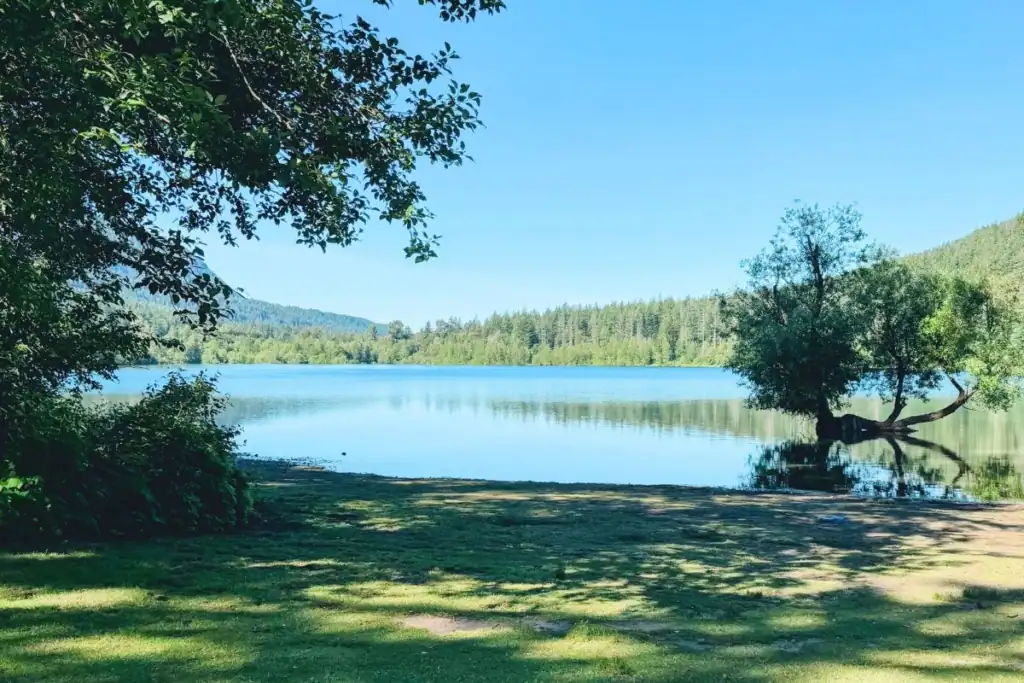
You don’t have to hike Rattlesnake Ledge to make the trip worthwhile.
Whether you want to spend the afternoon swimming, kayaking, enjoying a picnic, or simply relaxing by the water with a good book, there’s plenty to do right around the lake.
Pack a Picnic and Stay Awhile
Honestly, this is how I’ve spent most of my time at Rattlesnake Lake over the years.
Bring lunch, find a spot along the shoreline, and settle in.
There are designated picnic areas, but I love simply finding a comfortable place near the water, away from the cars and parking areas.
It’s especially fun if you’re planning to hike, because you can look across the water at that giant rock face and think, Wait…am I really going all the way up there?
Yes, you are. Or at least, that’s usually the plan.
Swim in Rattlesnake Lake
On a warm summer day, Rattlesnake Lake is a popular place to swim.
There’s no lifeguard, so swimming is at your own risk… and remember, this is a mountain-fed Washington lake.
The water can be cold, even when the sunshine makes it look inviting.
Where Is Rattlesnake Lake?
Rattlesnake Lake is located about three miles southeast of North Bend, Washington, in the foothills of the Cascade Mountains.
Surrounded by evergreen forests and mountain scenery, it’s a popular destination for hiking Rattlesnake Ledge, kayaking, swimming, picnicking, and enjoying a relaxing day beside the water.
It’s also an easy day trip from Tacoma, Seattle, and other South Sound communities.
Approximate driving distances and times:
- From Tacoma: 60–65 miles, about 1 hour 10 minutes to 1 hour 30 minutes.
- From Seattle: 35 miles, about 40–50 minutes.
- From North Bend: 4–5 miles, about 10 minutes.
To reach Rattlesnake Lake, take I-90 Exit 32 and follow Cedar Falls Road SE approximately three miles to the recreation area.
Parking is free at the Rattlesnake Lake Recreation Area, and no Discover Pass is required for the lake and Rattlesnake Ledge parking area.
Keep in mind that summer weekends can be especially busy, so arriving early is a good idea.
If you have kids or teenagers, there’s one spot along Rattlesnake Lake that might become their favorite part of the entire trip.
Near the Rattlesnake Ledge trailhead, close to the shoreline and portable restrooms, there’s a large rock that has been a favorite hangout for my family for years.
My kids loved jumping from it when they were younger, and later the grandkids enjoyed it too.
Honestly, I don’t think I could have convinced some of the teenagers to come along if that rock wasn’t there!
It’s become part of our family tradition.
One thing to know… Rattlesnake Lake’s water level changes throughout the year.
Sometimes the rock is surrounded by water, while at other times it’s completely exposed along the shoreline.
I’ve always been careful to check the water depth and conditions before allowing the kids to jump, and my younger grandkids wore life jackets.
Even when the rock is surrounded by water, that doesn’t automatically mean it’s safe for jumping.
Submerged rocks, changing water levels, and cold water can create serious hazards, so I wouldn’t recommend jumping without thoroughly assessing the conditions.
Rattlesnake Lake has no lifeguards.
What I really like about this part of the lake is how easy it is to spend the whole day here.
The trailhead and portable restrooms are close by, so it’s simple to settle in with a picnic, enjoy the sunshine, and let everyone hang out by the water.
For our family, this little corner of Rattlesnake Lake has been the backdrop for some great summer memories.
Fishing at Rattlesnake Lake
Yes, fishing is allowed at Rattlesnake Lake!
In fact, it’s open to fishing year-round, although there are a few important rules to know before casting your line.
The lake is home to rainbow trout and cutthroat trout, and anglers can fish from the shoreline or a small boat.
Washington’s selective gear rules apply here, which means bait fishing isn’t allowed.
Anglers must use artificial lures or flies with single-point barbless hooks.
Under the current regulations, trout must be at least 14 inches long to keep, with a daily limit of two fish per person.
A valid Washington freshwater fishing license is generally required for anglers age 15 and older.
If you’re fishing from a boat, only nonmotorized watercraft and electric motors are permitted. Gas-powered motors are prohibited.
One thing to keep in mind is that Rattlesnake Lake’s water level changes considerably throughout the year, especially during summer.
This can affect shoreline access and boat launching.
Before your visit, check the Washington Department of Fish and Wildlife’s Rattlesnake Lake fishing information for current regulations and any emergency rule changes.
Kayak or Paddleboard
Rattlesnake Lake is also a beautiful place to bring a kayak or paddleboard.
Only self-propelled watercraft and boats with electric motors are allowed, which helps keep the lake quieter than places dominated by motorboats.
Paddling out onto the lake also gives you a completely different perspective of Rattlesnake Mountain towering above the water.
Walk Along Rattlesnake Lake
If you’re not interested in climbing to the ledge, there’s a much easier option.
A combination of paved and packed-gravel paths follows the southeast side of Rattlesnake Lake toward the Cedar River Watershed Education Center.
It’s about 3/4 mile to the center and is considered a very easy, accessible route.
This is a great option for families, grandparents or anyone who wants to experience the scenery without tackling the elevation gain of Rattlesnake Ledge.
Visit the Cedar River Watershed Education Center
Don’t overlook the Cedar River Watershed Education Center at the lake’s south end.
The center has free exhibits about the Cedar River Watershed, wildlife, local history, and the system that provides much of the Seattle area’s drinking water.
One of the most unusual features is the Rain Drum Courtyard, an art installation where water droplets create rhythms on a collection of drums.
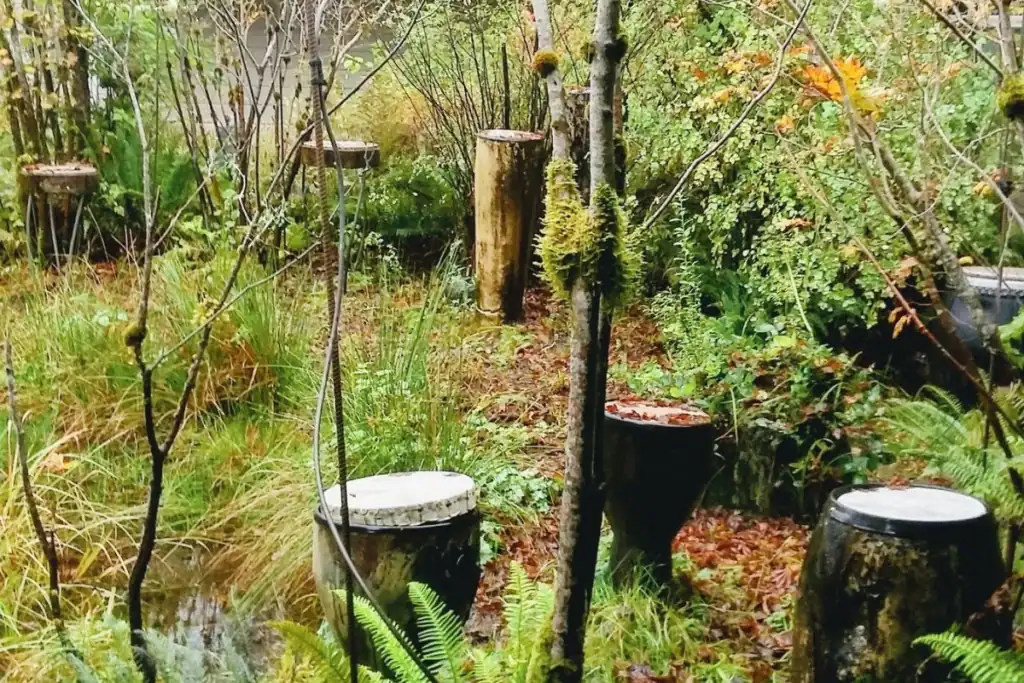
I’ve actually made the trip here just to experience the rain drums. There’s something so peaceful about standing among the trees, listening to the raindrops create their own rhythm.
The center is also located at the historic site of an old Milwaukee Road railroad camp, which brings us to one of my favorite things about Rattlesnake Lake.
An entire town lies beneath that water.
Well…sort of.
The Lost Town Beneath Rattlesnake Lake
This is where Rattlesnake Lake becomes more than just another pretty Washington lake.
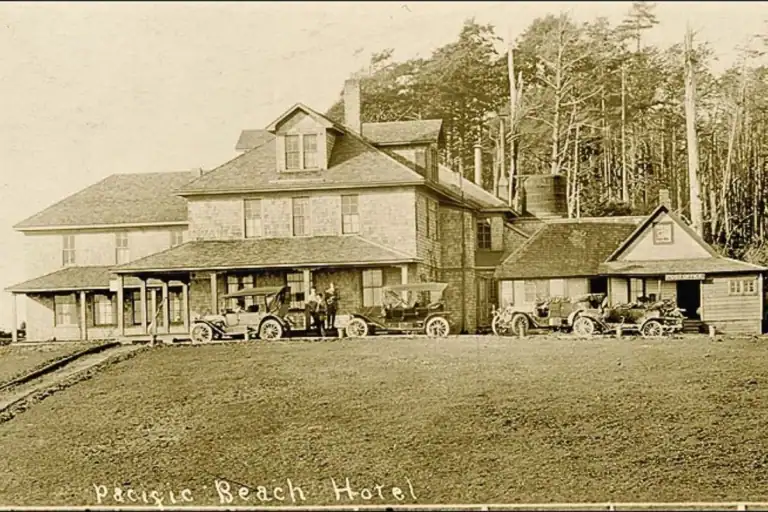
In the early 1900s, a community called Moncton developed along what was then a much smaller body of water sometimes called Rainy Season Lake.
Moncton was connected to the Chicago, Milwaukee and St. Paul Railway and nearby water and power projects. By 1915, more than 200 people lived there.
This wasn’t just a handful of cabins in the woods.
The town had homes, stores, a school, a hotel, restaurant, barbershop, saloon and even an indoor swimming pool.
Then the water started rising.
How Moncton Became Rattlesnake Lake
The City of Seattle had constructed Masonry Dam nearby as part of its growing water and hydroelectric system.
When the reservoir behind the dam filled in 1915, water began seeping through the porous glacial material separating it from Moncton.
Rattlesnake Lake began to rise.
Slowly, the water overtook the town.
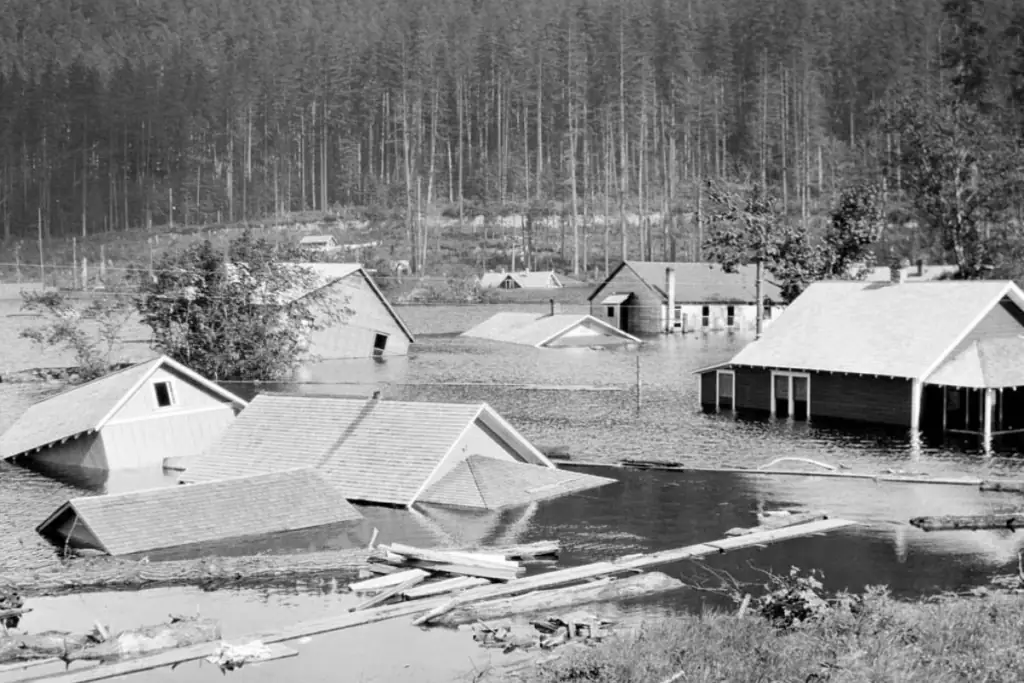
Residents were forced to leave, Moncton was eventually condemned, and the expanded body of water became Rattlesnake Lake as we know it today.
When lake levels are particularly low, remnants associated with the old town site can sometimes become visible near the shoreline.
Knowing that history completely changes the way I look at the lake.
People are swimming, kayaking, and picnicking in a place where families once lived, kids went to school, and trains rolled through more than a century ago.
Read History Link’s account of the Moncton flood to learn more.
Cedar Falls and the Railroad History
Moncton wasn’t the only community here.
Nearby Cedar Falls developed around Seattle’s water and power operations, while the Milwaukee Road brought railroad workers and trains through the area.
In 1912, the Moncton railroad depot was renamed Cedar Falls.
During the following decades, the Cedar Falls Depot became surprisingly busy, handling both passenger and freight trains.
That railroad history hasn’t completely disappeared.
The nearby Palouse to Cascades State Park Trail follows the historic Milwaukee Road railroad corridor and begins at the Cedar Falls Trailhead near Rattlesnake Lake.
So when you walk or bike portions of this trail today, you’re traveling along a route that once carried trains across Washington.
You can still find evidence of that railroad history if you walk beyond the area of the Education Center.
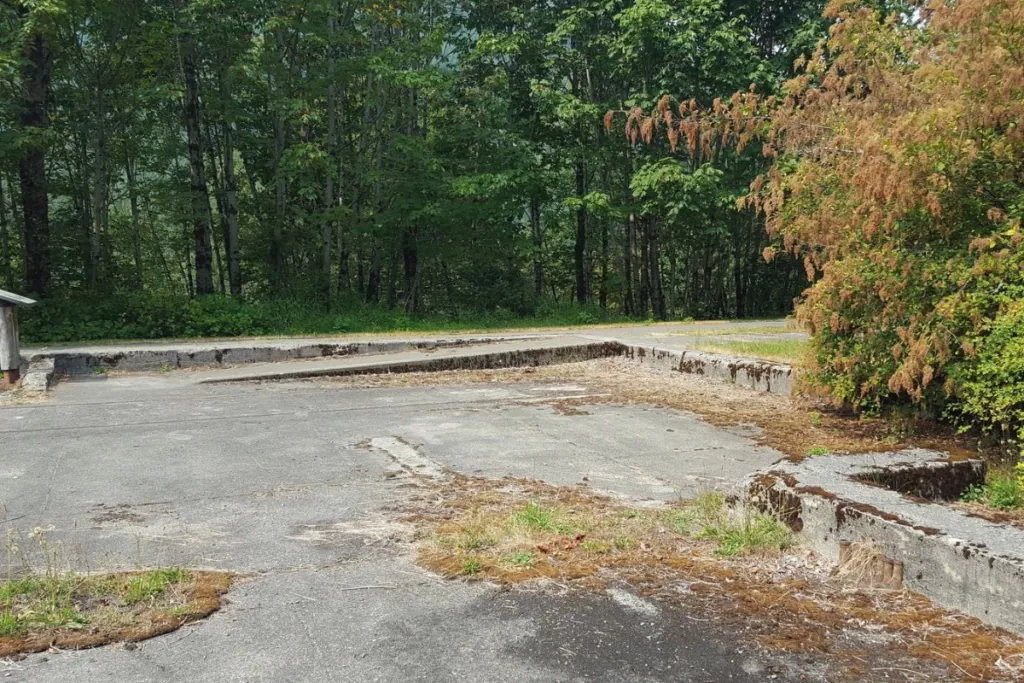
One of those reminders is the old concrete foundation of the Cedar Falls Substation. It’s easy to walk right past without realizing what you’re looking at, but this was once part of the infrastructure that helped power electric trains over Snoqualmie Pass.
I love finding these little pieces of history hiding in plain sight.
Exploring Rattlesnake Lake When the Water Is Low
I have to admit, my favorite time to visit Rattlesnake Lake is when the water level drops and the place looks a little less postcard-perfect.
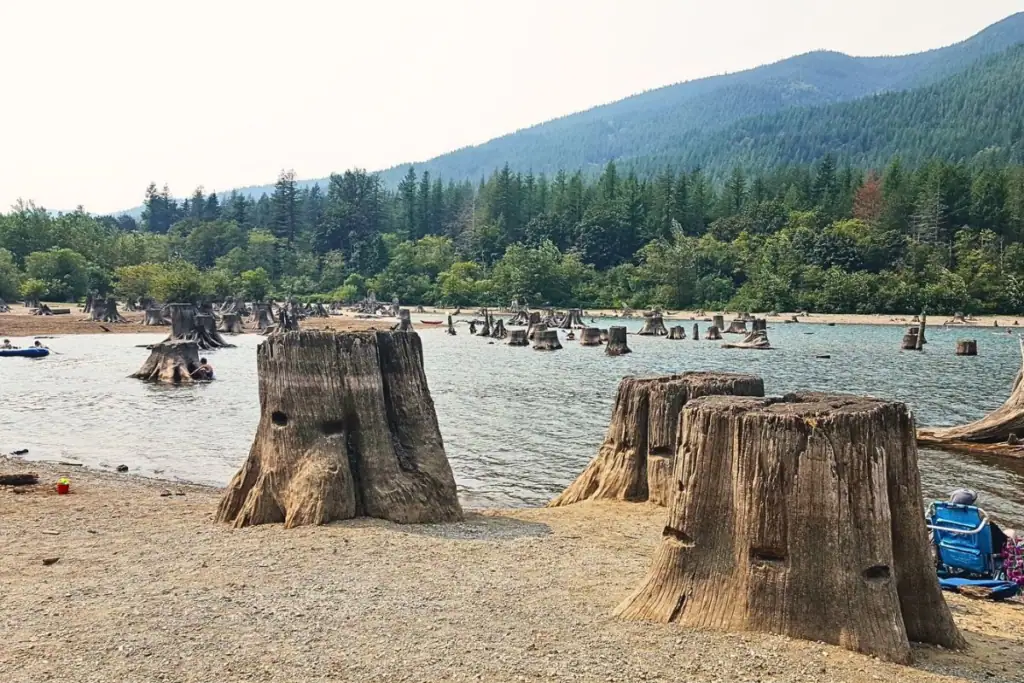
Most folks seem to prefer the classic view… turquoise water, Cascade peaks, the whole picture-perfect scene. I get it. I like that version, too.
Yet I find it strangely captivating to glimpse the secrets usually tucked away beneath the surface.
As the water retreats, massive old tree stumps emerge from the muddy lakebed.
Some still bear those rectangular notches, carved by loggers over a century ago, like silent signatures from another time.
Those notches are called springboard notches.
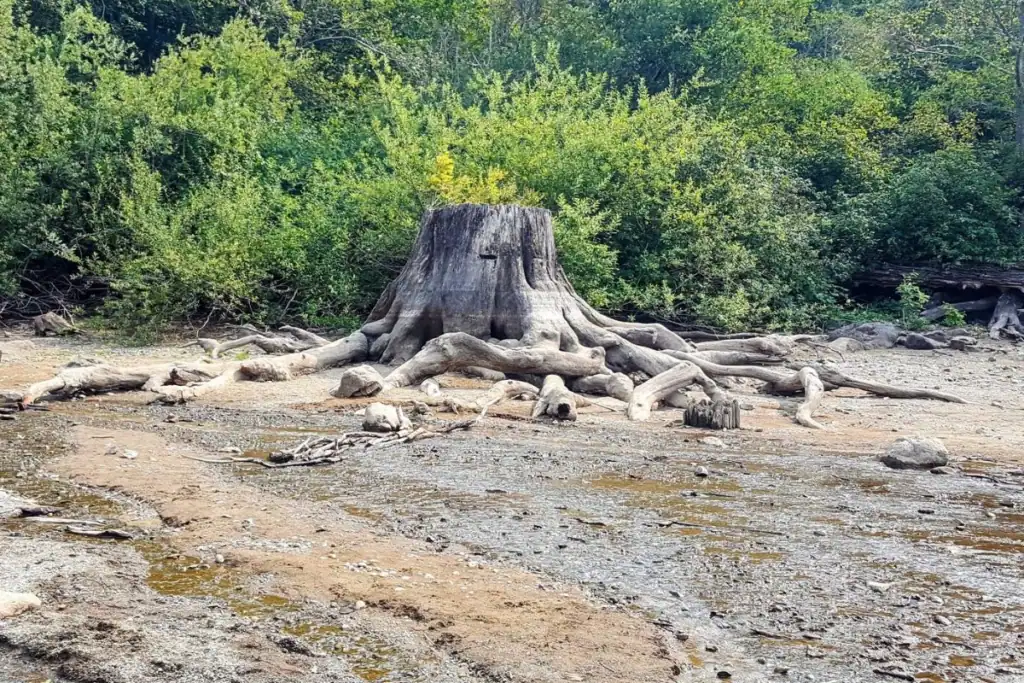
Early loggers would wedge wooden planks into them, then balance up there to saw down trees the size of small houses. That must have been hard work!
It never fails to amaze me that these marks have endured for so many years, still visible to anyone who looks closely.
Standing among those ancient stumps, I find myself imagining the valley as it once was, before the trees fell, before the dam, before everything changed.
It’s another glimpse into the area’s logging history… right up there with the remnants of the old town of Moncton that sometimes peek out when the water’s low.
When the water sinks low enough, I’ve wandered all the way around the lake, exploring stretches of shoreline that are usually kept secret.
Honestly, many of my favorite memories here have nothing to do with climbing Rattlesnake Ledge at all.
One afternoon, I came across a great blue heron standing in the shallows near the far end of the lake. Of course, I had to stop and watch.
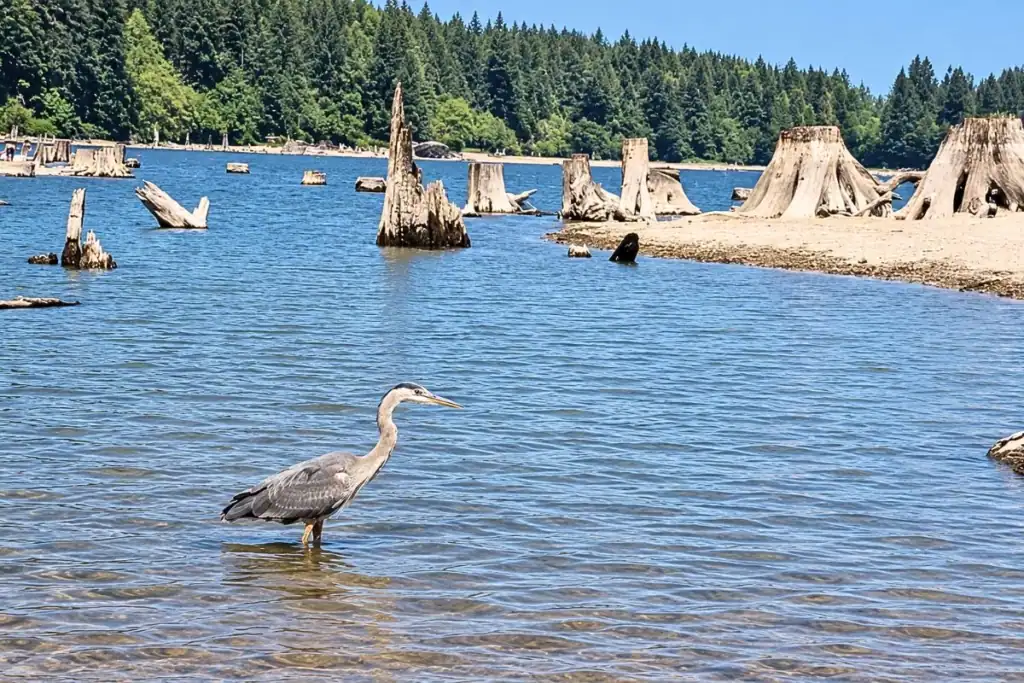
(AI-enhanced recreation from my original video footage, as it was too grainy)
I stood transfixed as it waited, motionless, then finally struck at a fish with a flash of precision. That kind of patience is something I can only dream of.
Great blue herons have always held a special place in my heart.
No matter how many times I see one, I still feel lucky to have witnessed a little moment in its world.
These are the moments I cherish most outdoors.
When you slow down and really look, you never know what wonders you might stumble upon.
So if you show up at Rattlesnake Lake and the water’s lower than you expected, don’t be too quick to feel let down.
Give yourself time to wander.
Explore the old stumps, notice the history beneath your feet, and watch for wildlife along the exposed shoreline.
You might just discover a completely different side of Rattlesnake Lake.
Just keep in mind that water levels change year-round. The exposed lakebed can get muddy, uneven, or a little unpredictable, so walking all the way around isn’t always possible… or wise. Stick to public land and try not to disturb any of the old remnants.
Hiking Rattlesnake Ledge
Of course, one of the biggest reasons people visit Rattlesnake Lake is to hike up to Rattlesnake Ledge.
It’s approximately 4 miles round trip with 1,160 feet of elevation gain. Not an especially long hike, but there’s enough climbing to make you appreciate the view waiting at the top.
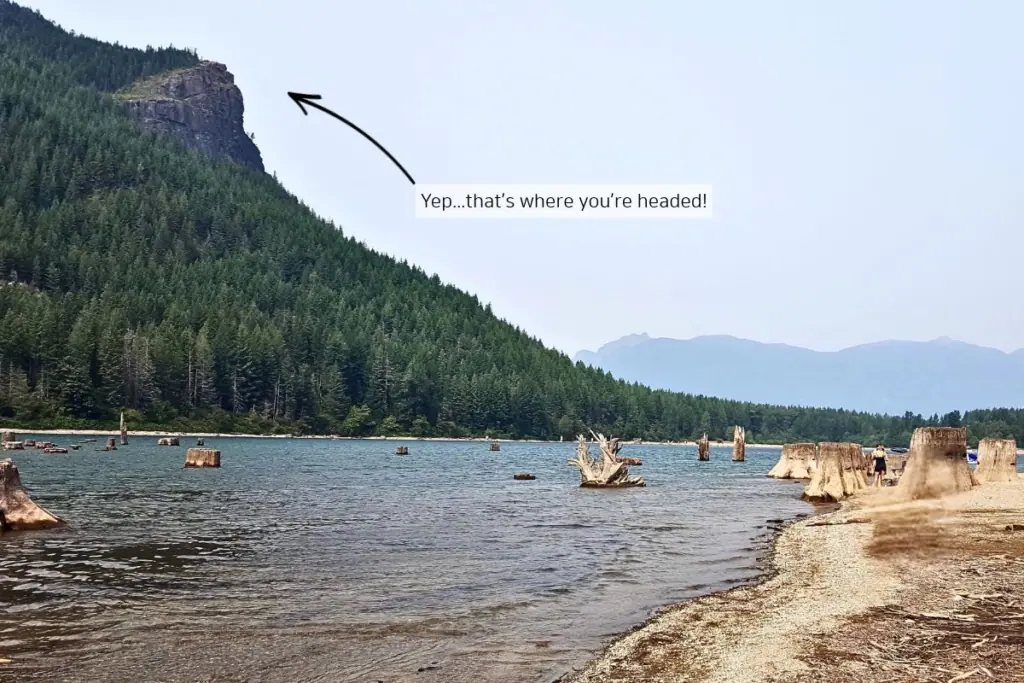
I’d call it moderate… enough to get your heart rate up, but not a sufferfest.
You don’t need to be an expert hiker, but don’t let the four-mile distance fool you. It’s not just a stroll through the woods.
You’re climbing for most of the way up.
Has Rattlesnake Ledge Trail Always Been This Way?
I remember first hiking Rattlesnake Ledge many years ago and thinking the trail was much steeper than it is today.
For a long time, I wondered whether I was remembering it correctly or whether hiking had simply gotten easier for me over the years.
Turns out, the trail really has changed!
The original route was considerably steeper, climbing more directly up the mountainside.
In the early 2000s, volunteers helped rebuild the trail, adding switchbacks that made the climb more gradual.
The improvements added about half a mile to the hike but made the ascent more manageable.
So if you’ve been hiking Rattlesnake Ledge for decades, you might remember a very different trail from the one visitors experience today.
I love discovering little pieces of history like this, especially in places I’ve been visiting for years.
What Is the Rattlesnake Ledge Trail Actually Like?
This is something I think descriptions of Rattlesnake Ledge overlook.
Everyone talks about the view.
And yes, the view is beautiful.
But I really enjoy the trail itself.
After leaving the lake, you quickly enter a classic Pacific Northwest forest.
The trail is mostly dirt, with rocky stretches, roots, and a series of switchbacks steadily carrying you uphill.
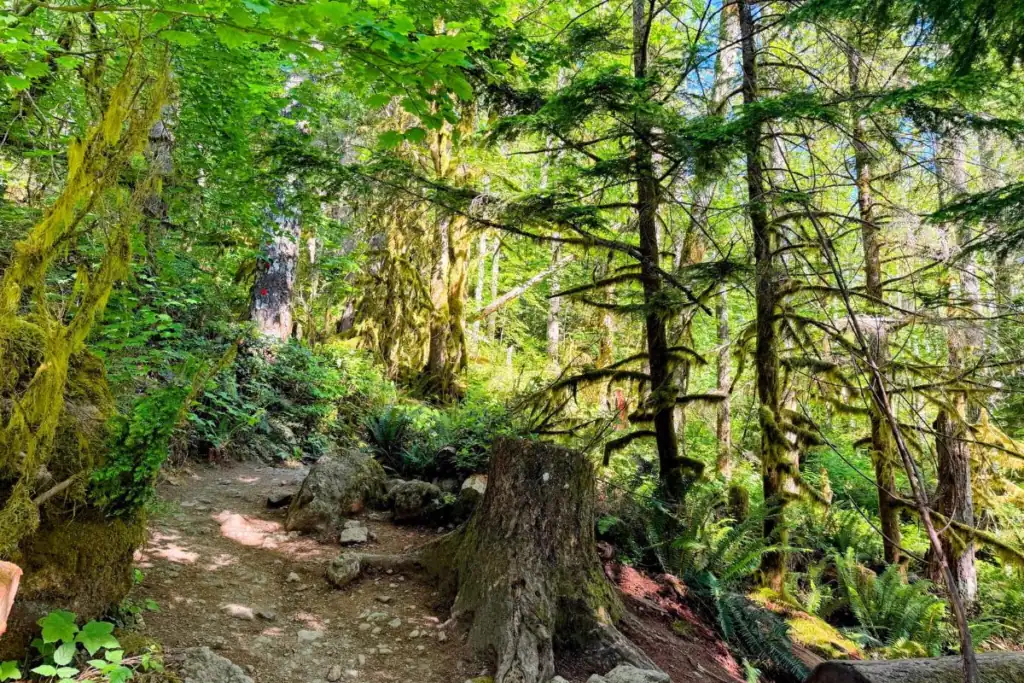
Tall evergreens and moss surround you, and enormous glacial boulders appear among the trees.
Some are so massive that you can’t help but stop and wonder how they ended up there.
They give the lower part of the hike an almost prehistoric feeling, especially when they’re covered in moss and ferns.
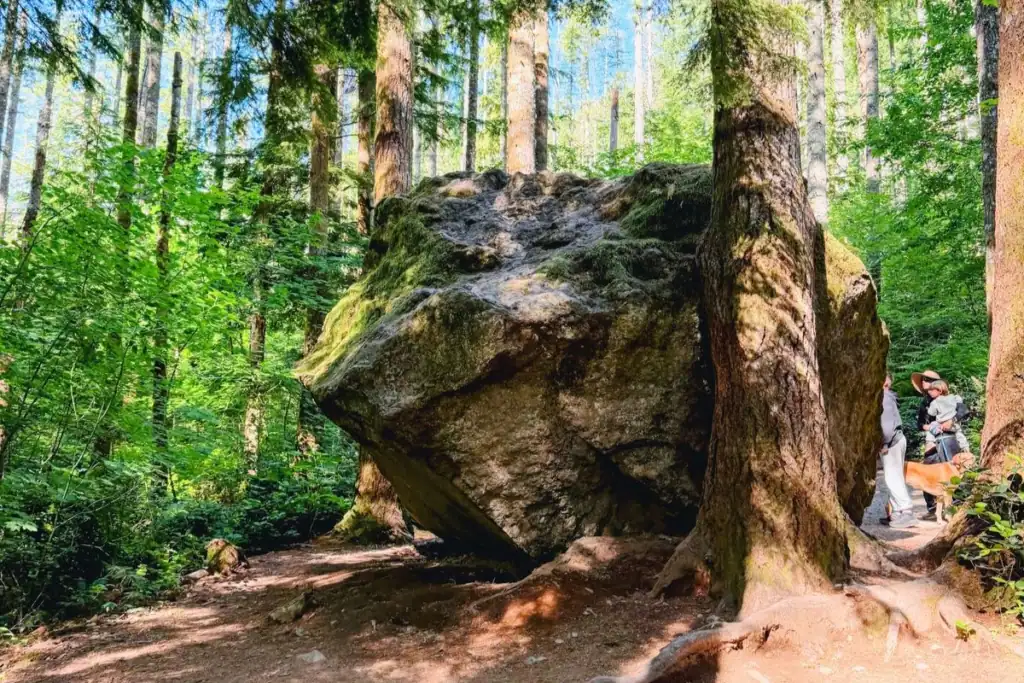
This is also where I start paying attention to what’s happening around me rather than simply marching toward the viewpoint.
We’ve seen busy little Douglas squirrels scurrying about the forest and heard woodpeckers tapping somewhere high above us.
It’s shady, earthy, and very Pacific Northwest.
That’s part of what I love about this hike.
The ledge might be the destination, but the forest is part of the experience.
Is Rattlesnake Ledge Hard?
The trail climbs steadily, but the switchbacks keep the grade manageable.
For regular hikers, it will probably feel like a moderate workout.
If you’re newer to hiking, take your time.
There’s nothing wrong with stopping to catch your breath, drink some water, and admire one of those giant mossy boulders while you’re at it.
You’ll gain about 1,160 feet over approximately two miles before reaching the ledge.
The trail is usually well maintained, but it’s still a natural trail… dirt, rocks, and exposed roots.
Wear comfortable shoes with good traction, not regular street shoes… and please, leave the flip-flops at home.
Reaching Rattlesnake Ledge
As you near the top, the trail begins to level out, and you’ll come to an open area where the trail branches off.
From here, you can continue along the trails toward other viewpoints on Rattlesnake Mountain or follow the route toward the wooden stairs leading up to the main ledge.
And yes, after all that climbing, there are still a few more stairs.
Because of course there are.
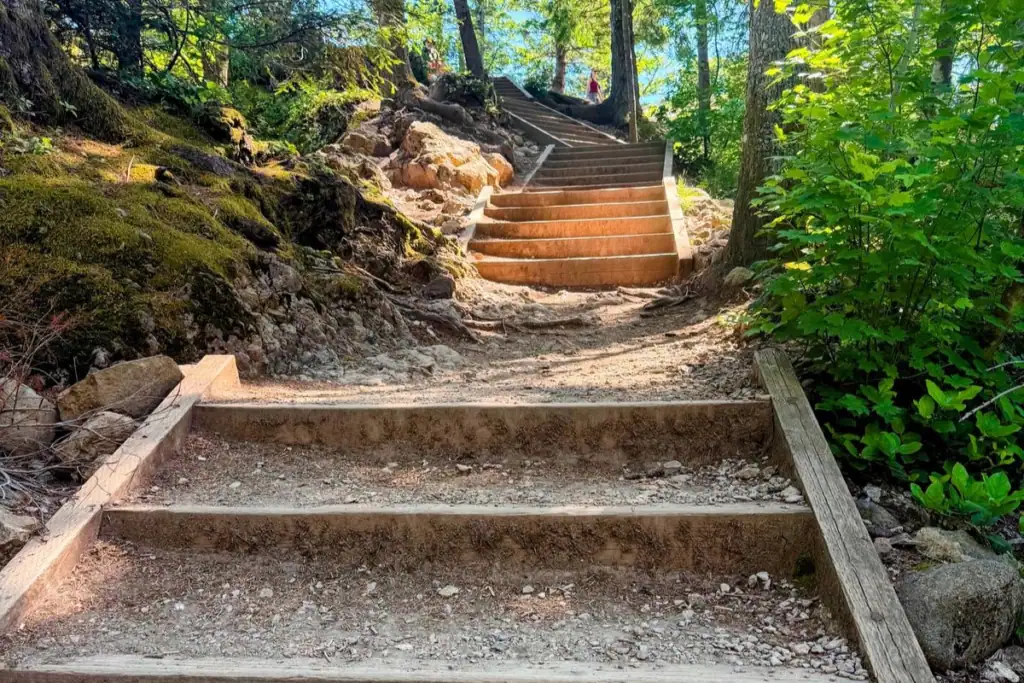
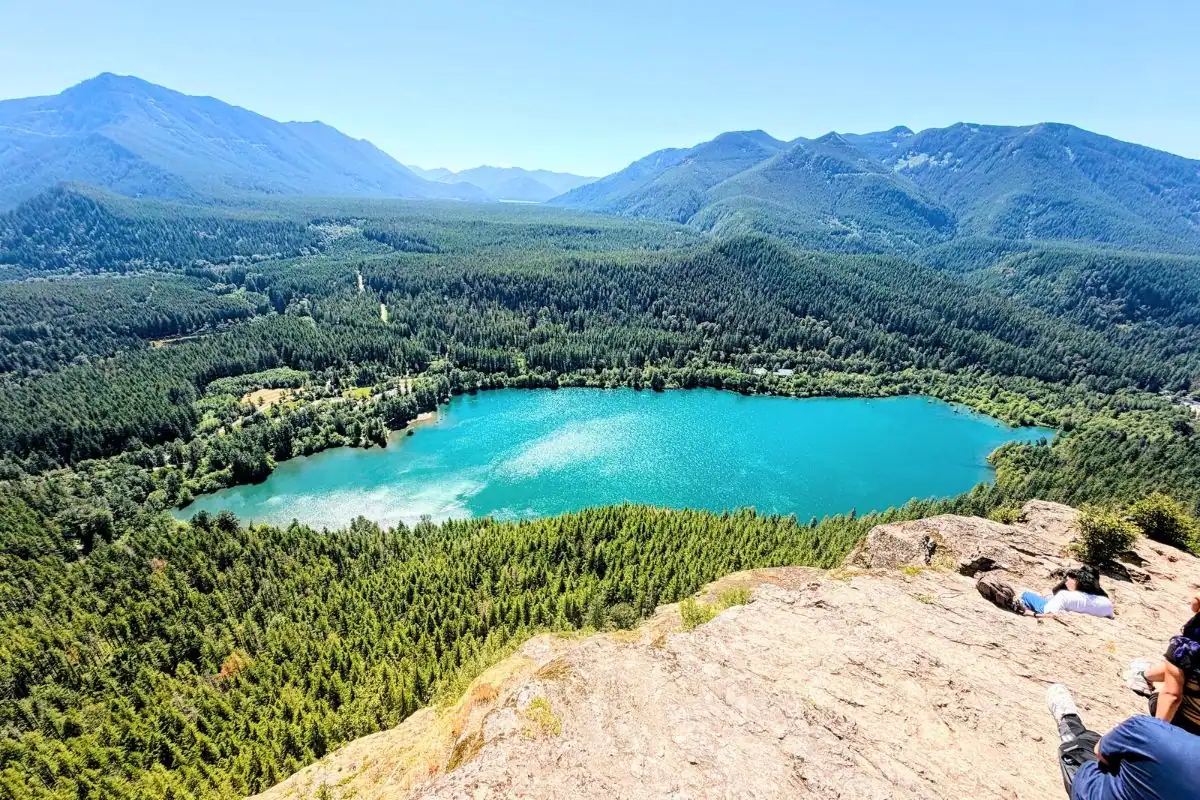
Once you reach the top, the forest opens up to incredible views of Rattlesnake Lake far below, surrounded by miles of evergreen forest and the Cascade foothills.
On a clear day, you can also see Mount Si and Mount Washington in the distance.
It’s easy to understand why Rattlesnake Ledge is one of the most popular hikes near Seattle.
Just be prepared for company.
The viewpoint can get crowded, especially on sunny weekends.
Between people coming and going, taking photos, and finding places to sit, it can feel a bit like a summit party.
And please be careful.
The ledge has steep, exposed cliff edges with no guardrails.
Give yourself plenty of room, keep children and dogs close, and don’t feel like you need to get near the edge for a great photo.
Take your time, find a comfortable spot away from the drop-offs, and enjoy the view.
You’ve earned it… and your legs will probably remind you later.
Want a Little More Hiking?
Most people turn around at Rattlesnake Ledge, but the trail doesn’t actually end there.
Rattlesnake Mountain Trail continues beyond the main viewpoint toward additional ledges and eventually across Rattlesnake Mountain.
If your goal is simply the classic Rattlesnake Ledge hike, though, the main viewpoint makes a natural turnaround point for the approximately four-mile round trip.
Other Trails Near Rattlesnake Lake
One reason I love exploring this part of the Cascade foothills is that there’s so much more to discover beyond Rattlesnake Ledge.
The North Bend area is filled with beautiful hiking trails, from easy walks along old railroad routes to forest paths leading to waterfalls and mountain viewpoints.
Whether you’re looking for something a little easier than Rattlesnake Ledge or want to explore somewhere new, there are several nearby trails worth checking out.
Palouse to Cascades State Park Trail from Cedar Falls
Just beyond Rattlesnake Lake, the Cedar Falls Trailhead marks the western end of the Palouse to Cascades State Park Trail.
This is the old Milwaukee Road railroad corridor, so instead of steep switchbacks, you’re traveling along a historic rail grade.
You can walk a short section or make it a much bigger adventure.
From Cedar Falls, the trail continues about 18 miles toward the Snoqualmie Tunnel.
Important: Parking at the Cedar Falls State Park trailhead requires a Discover Pass, unlike the free Rattlesnake Lake parking area.
Snoqualmie Valley Trail
The Snoqualmie Valley Trail also connects near Rattlesnake Lake and follows another former railroad corridor north toward North Bend, Snoqualmie, Carnation, and eventually Duvall.
It’s another good option if you want something longer but a lot gentler than climbing the ledge.
Twin Falls
Twin Falls is another hike I think is worth doing while exploring the North Bend area.
You can’t access it directly from the Rattlesnake Lake parking lot, so I wouldn’t try to squeeze both hikes into one day unless you’re feeling especially ambitious.
But if you’re staying in North Bend or coming back another time, it’s a great addition to your list.
What to Bring
You don’t need anything unusual for Rattlesnake Ledge, but I would bring:
- Comfortable hiking shoes with good traction
- Plenty of water
- Snacks or a picnic
- Layers, especially in spring and fall
- Sun protection for time around the lake
- A swimsuit and towel in warm weather
- Kayak or paddleboard if you’re planning time on the water
- The 10 Essentials if you’re hiking
- A camera because you’ll probably use it a lot
One thing that’s easy to miss… there’s no drinking water at the Rattlesnake Lake Recreation Area. You can fill up at the Cedar River Watershed Education Center, but I usually just bring what I need.
A Few Things to Know Before You Go
Rattlesnake Lake Recreation Area is open dawn to dusk year-round.
Parking is free, but this is an extremely popular destination. On sunny weekends, especially during summer, parking can fill quickly.
Portable toilets and picnic areas are available near the lake.
Swimming is allowed, but there are no lifeguards.
Camping and open fires are not allowed.
Drones are prohibited.
Dogs should be leashed, and please don’t feed the wildlife. The Douglas squirrels are cute and can be a bit demanding… but they really don’t need your trail mix.
Also remember that you’re right beside a protected municipal watershed. Stay within areas open to the public and respect posted closures.
Is Rattlesnake Lake Worth Visiting Without Hiking the Ledge?
Absolutely.
That’s probably the main thing I want people to know about this place.
Rattlesnake Ledge gets most of the attention, but Rattlesnake Lake is a destination in its own right.
Bring your kids. Bring your grandkids. Pack a lunch. Walk along the lake. Visit the education center. Learn about the town beneath the water. Go for a paddle. Or just sit in the sunshine and stare up at the ledge without hiking a single switchback, if that’s what sounds good that day.
And if you’re feeling adventurous, lace up your hiking shoes and head into the forest.
Why Rattlesnake Lake Is Still One of My Favorite Washington Day Trips
After coming here for so many years, I don’t really think of Rattlesnake Lake as someplace I need to “see.”
It’s someplace I return to.
I’ve watched my kids enjoy this lake, brought my nieces and nephews here, and now I get to bring my grandkids.
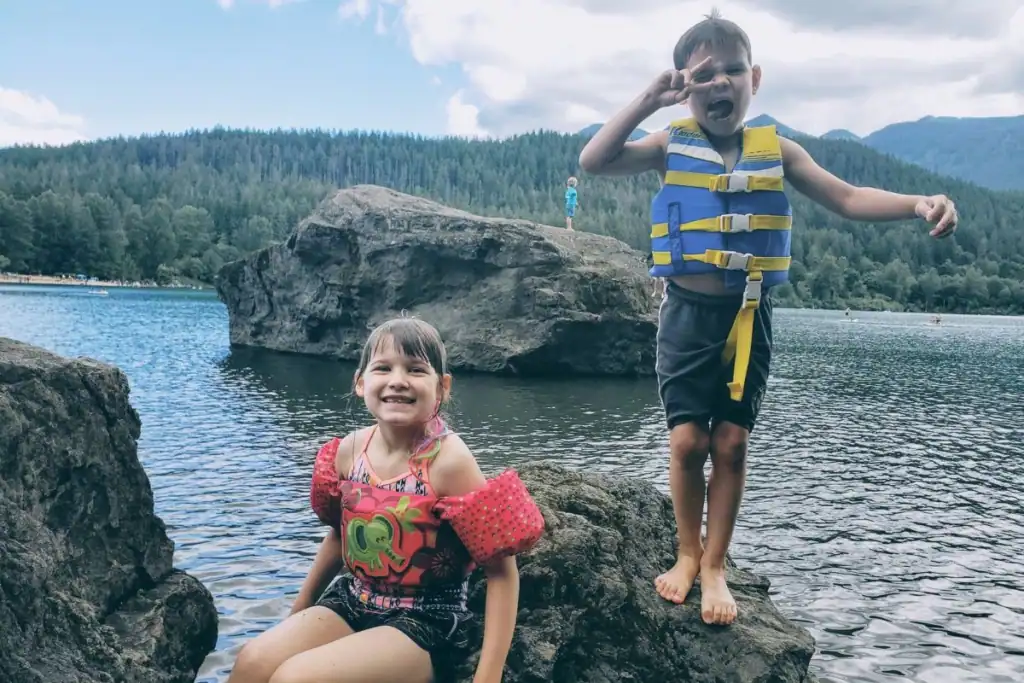
I don’t take that for granted.
There are certainly bigger lakes in Washington. There are longer hikes and higher viewpoints. Some places require hours of driving and elaborate itineraries.
Rattlesnake Lake doesn’t need any of that.
It’s close enough to Seattle for an easy day trip, beautiful enough to feel like you’ve escaped into the mountains, and flexible enough that you can make the day as adventurous—or as lazy—as you want.
Some days, that means climbing through the forest to Rattlesnake Ledge.
Other days, a picnic beside the lake is plenty.
And honestly… I love having both options.
Some days, I’m all about the climb.
Other days, a blanket by the water is just right.